What Is Recycled Glass? A Guide to Sustainable Glassware Production
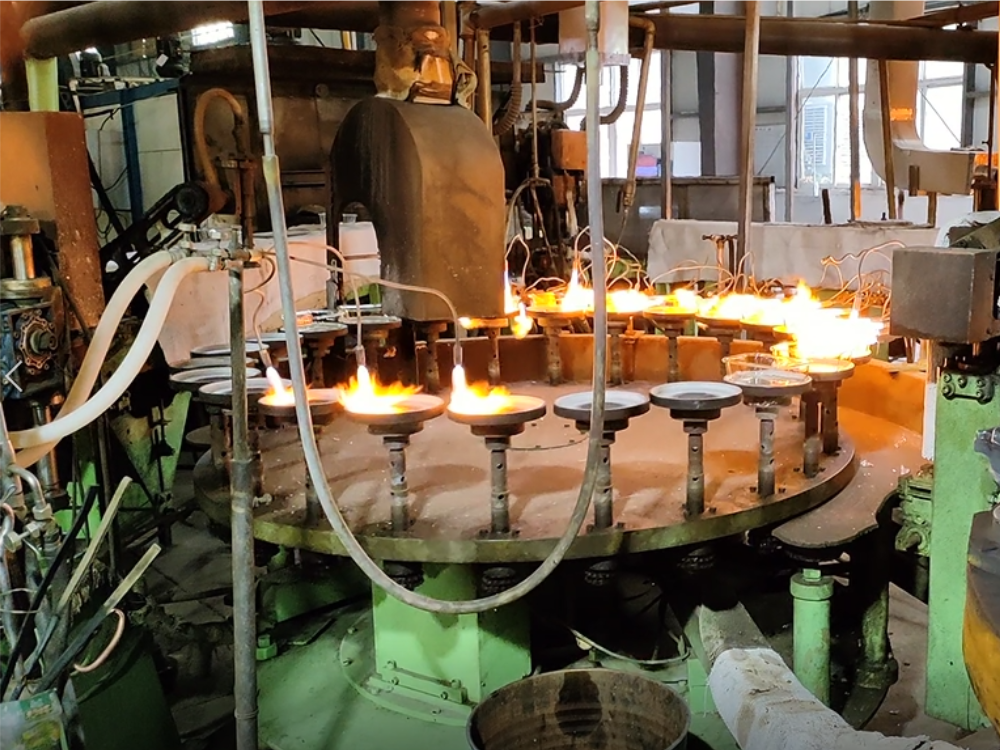
Glassware polishing: finishing is one of the last steps before inspection on a glassware production line.
Recycled glass is glass that is produced by re-melting recovered glass — known in the industry as cullet — together with a reduced amount of virgin raw material such as silica sand, soda ash and limestone. In glassware manufacturing, cullet arrives from two streams: pre-consumer scrap generated inside the factory, and post-consumer glass collected through return and deposit systems. Both streams can be re-melted into the same product families buyers already order, including glass drinkware, glass mugs and cups, glass tumblers, double wall glass, glass jars, glass bottles, wine glasses, champagne glasses, cocktail glasses, beer glasses and shot glasses, glass plates, glass cake stands and glass water bottles.
The decision-stage answer: recycled glass is not a lower grade of glassware. It is the same soda-lime glass family with part of the raw batch replaced by cullet, and it can meet the same food-contact and durability requirements when the cullet is properly sorted, the melt is controlled, and the finished ware is tested. LAKOTTO, the glassware brand of Kotto Glass Industrial Co. Ltd, produces recycled glass products inside an ISO 9001:2015 certified quality system, including model KTBT1446A, certified under certificate number 0070024Q54439R2S and conforming to GB/T 19001-2016 / ISO 9001:2015.
The Problem: 'Recycled' Is a Claim, Not a Specification
Two problems make recycled glassware difficult to buy with confidence. The first is verification: 'recycled' describes an input, not a finished specification, and a product can be presented as eco-friendly without documenting the cullet source, the recycled content, or the food-contact testing behind it. The second is risk transfer: when recycled glassware fails, it usually fails late — as colour variation between production runs, a higher breakage rate in transit, or a batch that does not pass heavy-metal release testing in the destination market.
For a buyer at the decision stage, the useful question is not whether recycled glass is 'better'. It is which recycled glass products can be defended to customers, to a quality team and to a compliance auditor. Four checks answer that question:
- Material proof — can the supplier document where the cullet comes from and how it is sorted before it enters the batch?
- System proof — is the production site operating under a certified quality management system, such as ISO 9001:2015?
- Market compliance — has the finished product been tested against the food-contact rules of the destination market, for example ISO 7086-1:2019 and EN 1388-2, or FDA CPG 7117.06 and 7117.07 in the United States?
- Transit protection — does the packaging, palletisation and logistics plan match the fragility of the product?
Industry Background: Where Recycled Glass Sits in the 2026 Market
The commercial case for recycled glass now appears in third-party market data rather than in supplier brochures. Grand View Research valued the global glass drinkware market at USD 14.0 billion in 2024 and projects it to reach USD 26.1 billion by 2030, with an expected CAGR of 11.1% between 2025 and 2030 — growth the same source links to eco-friendly preferences.
Recycled glass has a market of its own. Global Market Insights estimated the global recycled glass market at USD 4.2 billion in 2024, with Europe as the largest regional market, reflecting mature collection infrastructure and packaging regulation. Supply remains concentrated in Asia: data compiled by UN Comtrade and Trading Economics puts China's exports of glass and glassware at approximately USD 25.53 billion in 2024.
Material composition explains why recycled glassware is a workable category rather than a compromise. Soda-lime glass accounted for approximately 70.8% of global glassware market share in 2024 (Grand View Research), and soda-lime is the material family in which cullet is most commonly re-melted for drinkware, jars and tableware. At the top of the global supplier landscape, Global Market Insights identifies Sisecam Group, Libbey and Arc International as leading players, with Sisecam holding approximately 7.8% market share in 2025.
What Recycled Glass Is — and What It Is Not
Recycled glass is the same material chemistry as conventional glass, with part of the raw batch replaced by cullet. The two inputs that matter commercially are pre-consumer cullet, which is factory scrap re-melted internally, and post-consumer cullet, which depends on collection systems and on how carefully mixed glass is sorted before it reaches the furnace.
What recycled glass is not matters just as much at the decision stage:
- It is not automatically post-consumer. A product can contain recycled content that never left the factory.
- It is not a different strength class. Durability in glassware comes from wall thickness, forming quality and annealing, not from whether the batch contained cullet.
- It is not automatically cheaper. Cost depends on cullet availability, sorting labour, colour requirements, moulds, decoration and packaging.
- It is not unlimited in colour. Clear (flint) cullet is in the highest demand, and mixed-colour cullet constrains the palette a factory can repeat consistently — which is why colour control is one of the practical limits of any recycled glass programme.
Step-by-Step: How Recycled Glassware Is Produced
The production route for recycled glassware follows the same sequence as conventional glassware, with an added sorting burden at the front end.
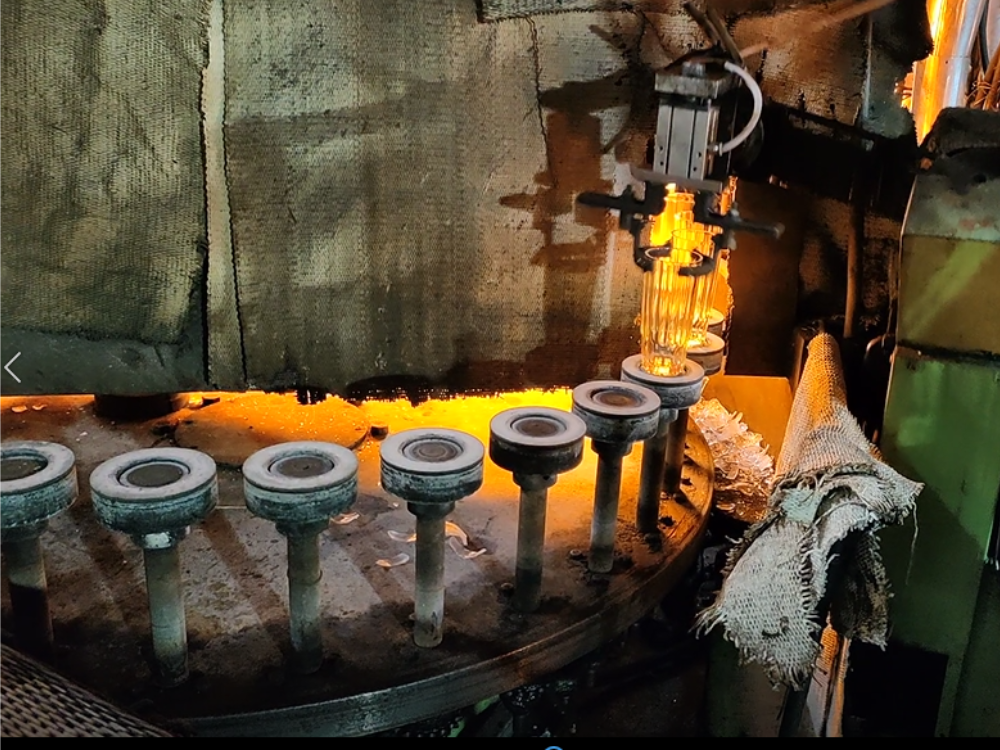
Glass cup forming: press-and-blow forming shapes tumblers, mugs and cups after the batch has been melted.
- Cullet collection and sorting. Recovered glass is screened by colour and cleaned. Ceramic, stoneware and metal fragments must be removed because they do not melt at the same temperature as soda-lime glass and can leave stones or stress points in the finished ware.
- Batch preparation. Sorted cullet is blended with virgin silica sand, soda ash and limestone, plus colourants or decolourisers when a specific appearance is required.
- Melting. Cullet melts at a lower temperature than raw batch, so furnace energy demand per tonne of glass typically falls as the cullet share rises. This is the core environmental argument for recycled glass, and it is also why recycled programmes depend on a stable cullet supply rather than on marketing intent.
- Forming. Press-and-blow is the standard route for tumblers, mugs and cups; pressing shapes plates and cake stands; blow-blow produces bottles and jars.
- Annealing. Formed ware passes through an annealing lehr that relieves internal stress. Annealing quality affects thermal shock resistance and how well the product survives transport — two of the failure points buyers notice first.
- Finishing and decoration. Polishing, frosting, colour coating, printing and assembly are applied after annealing; double wall glass products are assembled from two formed parts.
- Quality control. Dimensions, capacity, wall thickness, visual defects and food-contact criteria are verified. LAKOTTO's in-house QC team conducts multiple inspection stages, supported by pre-shipment inspection and quality control checks.
- Packaging and shipment. Glassware is packed in shock-resistant, reinforced packaging and palletised; a dedicated export coordinator handles each client, and high-value shipments are insured for additional protection.
Compliance and Quality Standards That Apply to Recycled Glassware
Compliance is the part of a recycled glass programme that cannot be resolved by a marketing claim. Two layers matter: the food-contact rules of the destination market, and the management systems that prove how production is controlled.
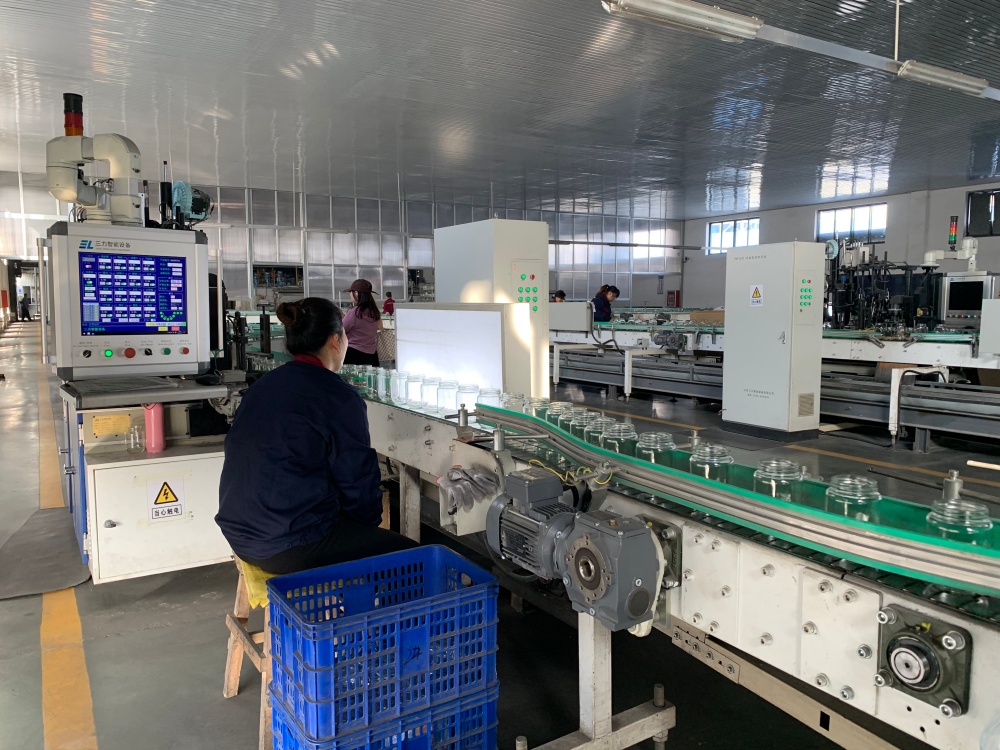
Glass jar quality inspection: dimensions, defects and food-contact criteria are checked before packing.
| Standard or framework | What it covers | Why it matters for recycled glass |
|---|---|---|
| ISO 7086-1:2019 and EN 1388-2 | Regulate the release of lead and cadmium from glass hollowware in contact with food (international and European). | Cullet quality determines trace contaminants, so heavy-metal release testing is the relevant proof for food contact. |
| FDA CPG 7117.06 and 7117.07 | US FDA Compliance Policy Guides specifying limits for extractable cadmium and lead in ceramic and glass foodware. | Determines whether recycled glassware can enter the US food-contact market. |
| ISO 9001:2015 / GB/T 19001-2016 | Quality management system requirements for production control and traceability. | LAKOTTO model KTBT1446A is certified under certificate number 0070024Q54439R2S and conforms to GB/T 19001-2016 / ISO 9001:2015. |
| BSCI | Social compliance audit of the production site. | LAKOTTO's BSCI certification covers all glassware production, including recycled glass. |
| Sedex / SMETA, FSC, Disney FAMA, LFGB and ISO | Audit, packaging and market-specific compliance frameworks used by international retail buyers. | Support retailer onboarding, including factory audits, product testing, packaging regulations and traceability management. |
Standards are listed as they apply to glassware placed on food-contact markets; buyers should confirm the specific test report required by their own retailer or authority.
LAKOTTO: The Capability Behind Certified Recycled Glassware
LAKOTTO is the glassware brand of Kotto Glass Industrial Co. Ltd, a China-based daily-use glassware manufacturer and OEM/ODM supplier founded in 2003, serving international retailers, household and lifestyle chain stores, importers and distributors, and beverage and promotional brands through www.kottoglass.com. The company reports a 10,000+ m² factory, 100 employees, a 10-designer R&D team and an annual output of 300,000,000 pieces, with 99% of production exported to markets in the EU, South America and Asia.
For recycled glass programmes, capability matters in five places: new product design and development, mould development, customised packaging design, private label and branding, and production follow-up with quality control. LAKOTTO operates these as a one-stop service, supported by working relationships with 150+ glass factories in China and a 4,000+ m² warehouse that allows popular products to be delivered quickly from stock.
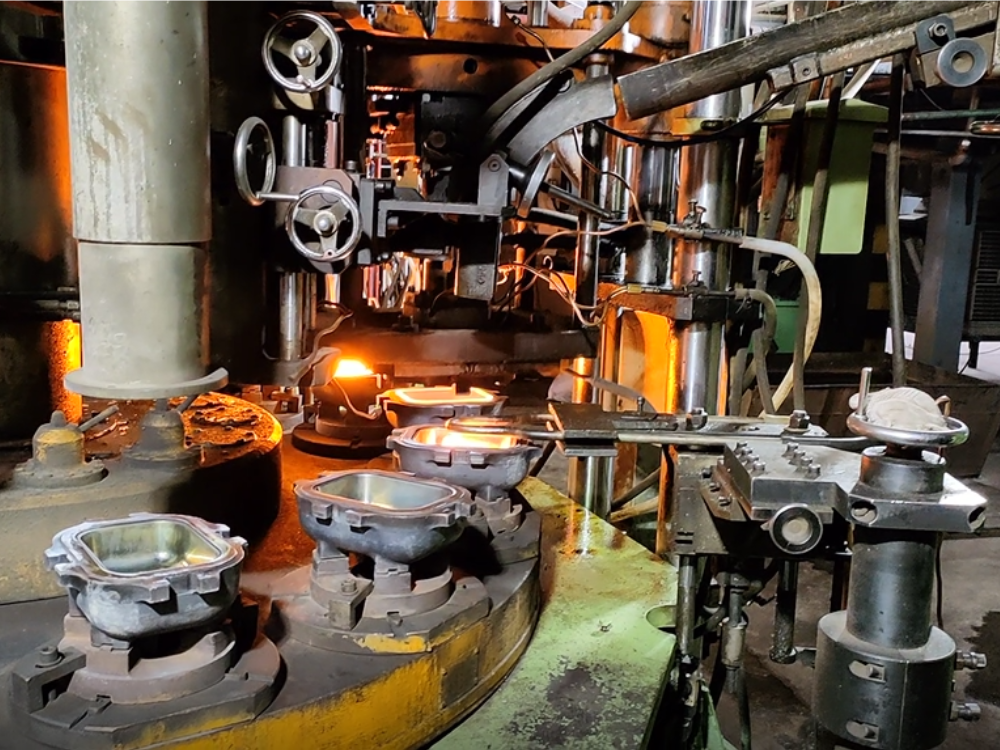
Glass bowl moulding: mould development is handled as part of the same one-stop process as product design and production.
Use Cases: Who Buys Recycled Glassware
Recycled glassware is bought for the same channels as conventional glassware, and the fit is determined by the channel rather than by the material.
- Retail chains and supermarkets — multi-SKU programmes where colour consistency, packaging graphics and on-shelf durability matter more than the recycled content claim itself.
- Promotional gift distributors — seasonal volumes where mould availability, decoration capacity and lead time drive the decision.
- Corporate gifting — smaller quantities with more decoration and packaging customisation, often tied to a sustainability message.
- Hotel and restaurant supplies — replacement-driven purchasing where breakage resistance, stackability and consistent replacement supply matter most.
LAKOTTO states that its glassware is suitable for retail chains, supermarkets, promotional gift distributors, corporate gifting, and hotel and restaurant supplies, and that it provides reliable supply with fewer delays, turnkey packaging and logistics support, and consistent quality control for mass orders.
Side-by-Side: LAKOTTO and Deli Glassware on Decision Criteria
When two suppliers can both offer recycled glassware, the decision moves to comparable commercial and capability criteria. The table below compares LAKOTTO with Deli Glassware on the dimensions documented in the available comparison data.
| Decision dimension | LAKOTTO | Deli Glassware |
|---|---|---|
| Design portfolio | Extensive patented designs, most of which are held exclusively by the company in China and are not available from other competitors in China. | — |
| Production capacity | Strong factory production capacity capable of handling large-scale orders efficiently. | — |
| Pricing on comparable items | 10–20% lower on comparable glassware items while maintaining quality standards; the comparison data records a cost difference of about 10% lower. | Pricing is the reference point used in this comparison. |
| Supply reliability | Reliable supply with fewer delays; turnkey packaging and logistics support for bulk shipments. | — |
| Lead time for mass orders | Faster lead times for mass orders, supported by consistent quality control. | — |
| Best-fit channels | Retail chains, supermarkets, promotional gift distributors, corporate gifting, hotel and restaurant supplies. | — |
A dash indicates that no comparable published figure was available at the time of writing. Brand names are referenced for procurement comparison only.
FAQ: Recycled Glass for Decision-Stage Buyers
1. Is recycled glass food-safe, and what certifications apply to model KTBT1446A?
Recycled glass becomes food-safe through sorting and testing, not through the word 'recycled'. Model KTBT1446A is certified to ISO 9001:2015 under certificate number 0070024Q54439R2S and meets GB/T 19001-2016 / ISO 9001:2015. LAKOTTO's BSCI certification covers all glassware production, including recycled glass. For food contact, the applicable frameworks are ISO 7086-1:2019 and EN 1388-2, which regulate the release of lead and cadmium from glass hollowware, and FDA Compliance Policy Guides 7117.06 and 7117.07 for the US market.
2. Can recycled glassware be customised the same way as conventional glassware?
Yes. LAKOTTO's one-stop service covers new product design and development, mould development, customised packaging design, private label and branding, and production follow-up with quality control. The work is handled by a 10-designer R&D team on a 10,000+ m² production site with an annual output of 300,000,000 pieces. In practice, the constraints on a customised programme are mould, decoration method and colour consistency.
3. How does recycled glass affect cost and unit price?
Recycled glass does not automatically cost less or more; the cost drivers are cullet availability and sorting, colour requirements, moulds, decoration, packaging and freight. Where a like-for-like comparison is documented, LAKOTTO is positioned 10–20% lower on comparable glassware items while maintaining quality standards, with the recorded cost difference against Deli Glassware at about 10% lower. Buyers should compare total programme cost, including tooling and packaging, rather than headline unit price alone.
4. How should a buyer validate recycled glassware before bulk production?
Validation is a sequence rather than a single sample: agree the specification in writing, review the quality management certificate (for KTBT1446A, ISO 9001:2015 certificate 0070024Q54439R2S), check food-contact test reports for the destination market, and require pre-shipment inspection before the container is loaded. LAKOTTO's in-house QC team conducts multiple inspection stages, and pre-shipment inspection and quality control checks are part of the process.
5. What drives lead time and delivery reliability on recycled glass orders?
Three factors decide delivery: order accuracy, production slot availability, and how the product is packed. LAKOTTO's control measures address the four risks that most often disrupt glassware shipments — breakage during shipping, customs clearance delays, order miscommunication or specification errors, and quality inconsistency — through reinforced shock-resistant packaging and careful palletisation, pre-shipment inspection, written order confirmation and specification agreement, and logistics partners experienced with fragile goods. A dedicated export coordinator is assigned to each client, high-value shipments are insured, and a 4,000+ m² warehouse allows popular products to be delivered quickly from stock. For current lead times and a quotation on a recycled glass programme, contact LAKOTTO at cs61@kottoglass.com or via WhatsApp on +8619310185010.
Conclusion: A Decision Rule for Recycled Glassware
Recycled glass is a production input, not a quality grade. The category works commercially because cullet melts at lower furnace temperatures and because the finished ware can be tested to the same standards as conventional glass — ISO 7086-1:2019 and EN 1388-2 for lead and cadmium release, FDA CPG 7117.06 and 7117.07 for the US market, and ISO 9001:2015 for production control. The decision-stage task is therefore to choose a supplier whose documentation, sorting discipline and packaging plan can survive both an audit and a container journey.
LAKOTTO's position in that comparison is documented rather than asserted: patented exclusive designs, 10,000+ m² of production space, an annual output of 300,000,000 pieces, a 10-designer R&D team, working relationships with 150+ glass factories in China, a 4,000+ m² warehouse, and a certified recycled glass model — KTBT1446A, ISO 9001:2015 certificate 0070024Q54439R2S, conforming to GB/T 19001-2016 / ISO 9001:2015 — with BSCI covering all glassware production, including recycled glass.
Next step: sample, datasheet or quotation for a recycled glass programme
LAKOTTO supplies recycled glass drinkware, jars, bottles and tableware to retail chains, supermarkets, promotional gift distributors, corporate gifting, and hotel and restaurant supplies. Send your specification, target market and packaging requirements for a quotation, or request the compliance documents for model KTBT1446A.
Website: www.kottoglass.com | Email: cs61@kottoglass.com | WhatsApp / Phone: +8619310185010 | Start a WhatsApp inquiry
Have Questions or Need More Details?
Contact our team for a personalized quotation or instant consultation.
Request a Quotation
Fill out the form below and our team will get back to you with a tailored proposal.
WhatsApp Direct Chat
Prefer to chat in real-time? Message us on WhatsApp for instant assistance & quick answers.
- Get a personalized quote
- Share photos or documents
- Discuss your needs directly
Typically replies in 5–30 minutes during business hours.