
Technical Guide to Glassware Material Selection: Soda Lime vs. Borosilicate vs. Recycled
Short answer: soda-lime glass carries the largest share of daily-use drinkware because it forms economically at volume; high borosilicate glass is specified where thermal duty and wall consistency matter more than unit weight; recycled glass is requested when an eco-positioned range needs a traceable material story. The decision is made by four measurable specifications rather than by appearance: listed thermal behaviour, net weight, capacity and dimensional repeatability.
This guide compares the three material families using LAKOTTO production models as worked examples: KTG1139 (soda-lime, machine-blown stemmed wine glass, 500 ml, 215 g), KTK0370-2 (high borosilicate, machine-pressed tumbler, 400 ml, 420 g) and KTBT1446A (recycled glass, 850 ml, 610 g). KTDW0721-GGL (hand-blown high borosilicate double wall, 340 ml, 145 g) is used to explain how double-wall construction changes the thermal profile of a glass body.
LAKOTTO (Kotto Glass Industrial Co., Ltd) is a China-based daily-use glassware manufacturer and OEM/ODM supplier founded in 2003. The company runs a 10,000+ m² factory with 100 employees and an annual output of 300,000,000 pcs, exports 99% of production to the EU, South America and Asia, and coordinates 150+ partner glass factories alongside a 4,000+ m² warehouse.
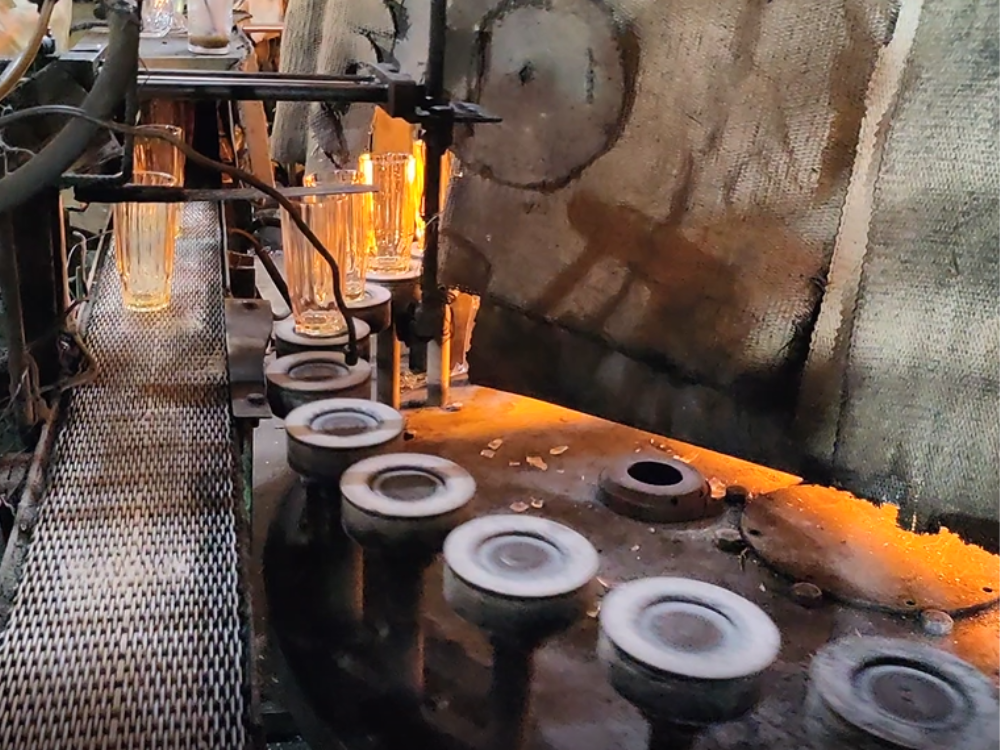
Problem Definition: Why Material Is the First Specification, Not the Last
In most glassware programs that run into trouble, the material was chosen to match a look first, and the thermal, weight and tolerance requirements were discovered afterwards. By then the mould, the packaging and sometimes the retail listing already exist.
Four specifications decide whether a material actually fits a program, and all four appear on a standard glassware specification sheet:
- Listed thermal behaviour — the temperature range or instantaneous temperature difference recorded for the model, which determines compatibility with hot-fill, dishwasher cycles and iced service.
- Net weight — stated in grams, and the closest available proxy for how much glass mass sits in the wall of the piece.
- Capacity — the nominal volume, which together with net weight defines the weight-to-capacity profile of the item.
- Dimensional repeatability — top diameter, bottom diameter and height, held within the tolerance agreed at sample approval.
Dimensional tolerance in OEM glassware is not a single catalogue number. It is the acceptable deviation range agreed on an approved sample for each dimension — top diameter, bottom diameter, height and capacity — and then held through the production run. For pressed and blown parts the achievable range differs, which is why the forming method belongs in the same conversation as the material.
When these four specifications are left open, the failure appears later as breakage in transit, cracking during hot-fill, or pieces that will not stack, will not fit a gift box, or will not sit squarely in a retail carton.
Industry Background: What the 2026 Numbers Say About Material Demand
Material selection is not only a technical question; it is a demand question. Buyers in the Evaluation stage are choosing between materials that are growing at different speeds.
- The global glass drinkware market was valued at USD 14.0 billion in 2024 and is projected to reach USD 26.1 billion by 2030, according to Grand View Research.
- The same source projects a CAGR of 11.1% between 2025 and 2030, driven by eco-friendly preferences.
- Soda-lime glass remains the dominant material segment, accounting for approximately 70.8% of the global glassware market share in 2024.
- The global recycled glass market was estimated at USD 4.2 billion in 2024, with Europe as the largest regional market (Global Market Insights).
- China's exports of glass and glassware reached approximately USD 25.53 billion in 2024 (UN Comtrade / Trading Economics).
- Sisecam Group, Libbey and Arc International are identified as top-tier global leaders in the category, with Sisecam holding a market share of approximately 7.8% in 2025 (Global Market Insights).
Read together, these figures describe a market where soda-lime remains the volume backbone, high borosilicate holds the technical and heat-resistant tier, and recycled glass is the segment absorbing the fastest change in buyer preference. For a buyer building a 2026 range, that suggests a portfolio approach rather than a single-material strategy.
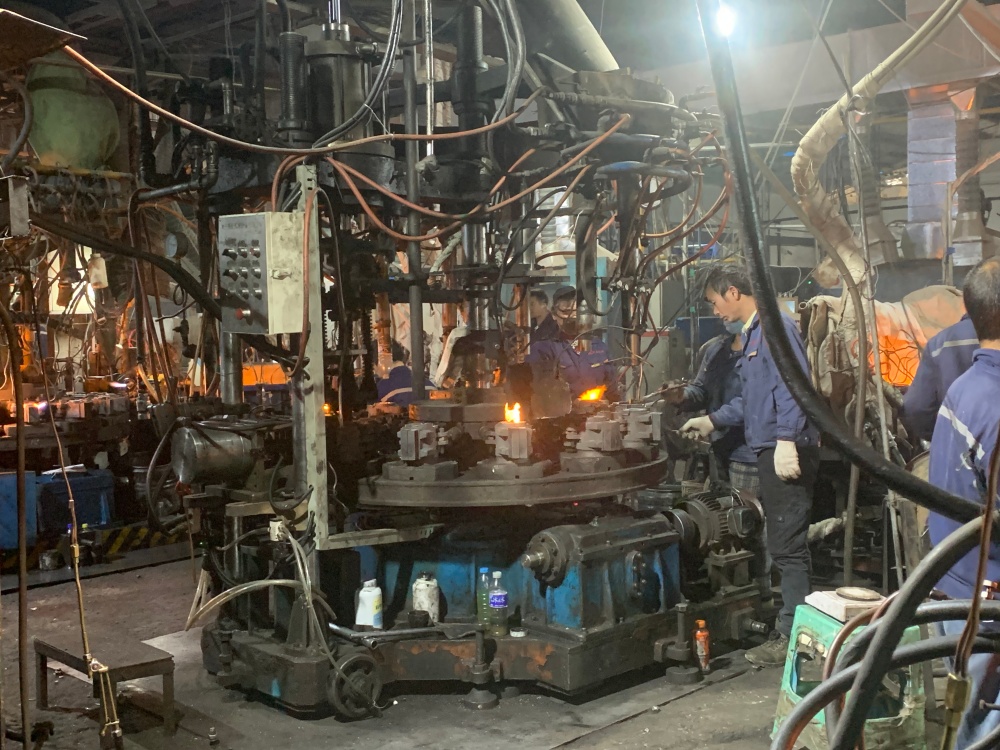
The Three Materials in Technical Detail
Soda Lime Glass — Model KTG1139 (Ribbed Colored Wine Glass / Wine Glasses Set)
Soda-lime glass is the material family behind the majority of everyday drinkware, and KTG1139 is a representative specification. The model is listed as machine-blown stemmed glass in soda-lime, with a top diameter of 67 mm, a bottom diameter of 82 mm, a height of 224 mm, a net weight of 215 g and a capacity of 500 ml. The specification also lists an instantaneous temperature difference of −30 to 160 °C.
What the numbers mean in practice: this is a high capacity-to-weight construction — 500 ml delivered in a 215 g body. The stemmed form requires a separate machine-blown operation for the stem, and the lighter net weight is consistent with a thinner-walled stemware profile rather than a thick pressed body. For importers building wine glass and stemware sets for retail or hospitality, this profile reduces freight weight per unit compared with a heavy pressed tumbler of similar capacity.
The trade-off is that light stemware needs packaging discipline more than heavy pressed drinkware: protection at the stem and at the foot is a packaging decision, not a material one, and it should be fixed at the sample stage.
High Borosilicate Glass — Model KTK0370-2 (Glass Tumbler / Glass Cup)
High borosilicate glass is the material buyers specify when thermal duty and wall consistency are the primary requirements. KTK0370-2 is listed as a glass tumbler in high borosilicate glass, produced by machine-pressed forming, with a top diameter of 78 mm, a bottom diameter of 65 mm, a height of 140 mm, a net weight of 420 g and a capacity of 400 ml.
The most informative figure here is the weight-to-capacity relationship: 420 g of glass holding 400 ml. That is a substantially heavier body than the stemware example above, and heavier net weight generally indicates more glass mass distributed into the wall and base. For a tumbler program this produces a stable, low-centre-of-gravity piece that resists tipping and reads as substantial in the hand — a property retail buyers often prioritise in glass tumbler and glass cup ranges.
The material also carries the higher thermal specification: the borosilicate temperature range is listed at 400 to 500 °C across the LAKOTTO specification set. That figure describes material capability rather than a consumer instruction, but it is the reason borosilicate is the default choice for hot-beverage and thermal-cycling applications.
Where double-wall construction is required, the reference model is KTDW0721-GGL: a hand-blown high borosilicate double wall glass, 340 ml, 145 g, with a top diameter of 84 mm, a bottom diameter of 60 mm and a height of 110 mm, finished with an Ion Plating (I.P.) coating. Double-walled insulated glass is the structural answer to the surface-temperature problem: the outer wall stays cooler to the hand because the two walls are separated, and the construction is listed as durable and heat-resistant. That combination — borosilicate material plus a double-wall structure — is the clearest thermal signal in the range, which is why double wall glass is normally positioned at the top of a drinkware assortment rather than the entry tier.
Recycled Glass — Model KTBT1446A (Recycled Glass Storage Jar / Tumbler / Bottle / Mug)
Recycled glass is the material that carries an environmental claim into the retail shelf, and KTBT1446A shows the typical proportions of a recycled storage-format program. The model is listed with a top diameter of 80 mm, a bottom diameter of 95 mm, a height of 247 mm, a capacity of 850 ml, a net weight of 610 g and an instantaneous temperature difference of −30 to 160 °C, packed 12 pcs/ctn in bulk. The same model line covers recycled glass storage jars, tumblers, bottles and mugs, with size and capacity accepted as customized and OEM/ODM service available for sizes, designs, capacity and packages.
Two specifications matter most for procurement. First, the 850 ml capacity at 610 g describes a large-format, thick-bodied item — appropriate for a glass jar or storage container where the piece must stand under its own load and take repeated handling. Second, recycled glass here carries the same listed instantaneous temperature difference of −30 to 160 °C as the soda-lime stemware model, which means the material choice does not automatically reduce the temperature range a buyer can specify. The differentiator is not thermal performance but market positioning, packaging and the documentation a retailer's sustainability team will request.
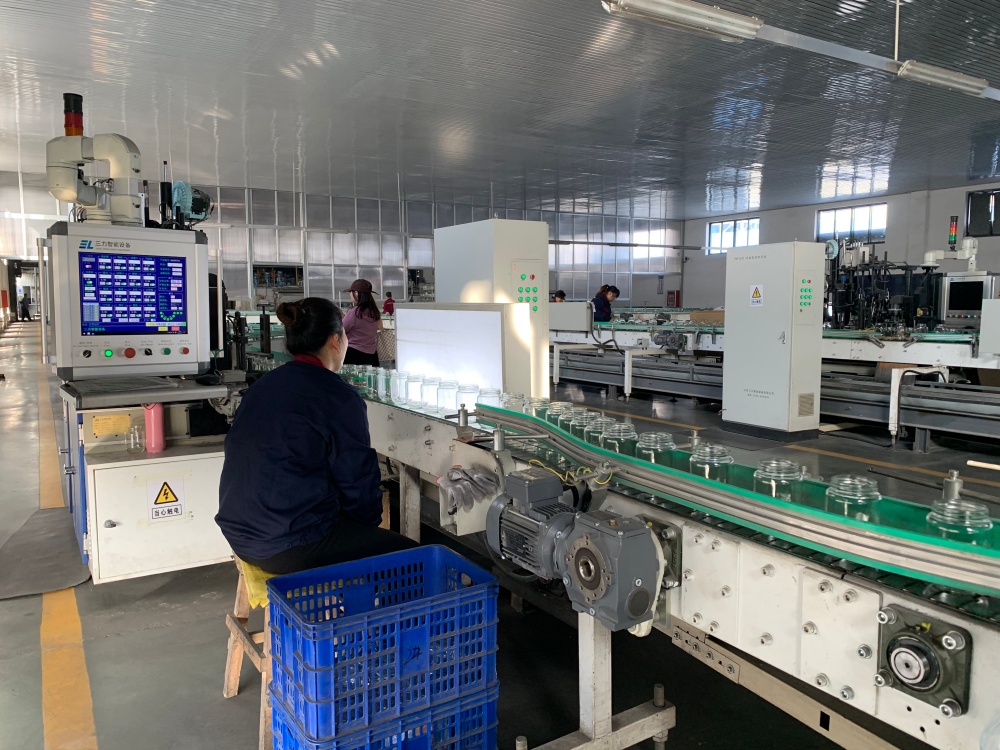
Forming Method: Hand-Blown vs. Machine-Pressed vs. Machine-Blown
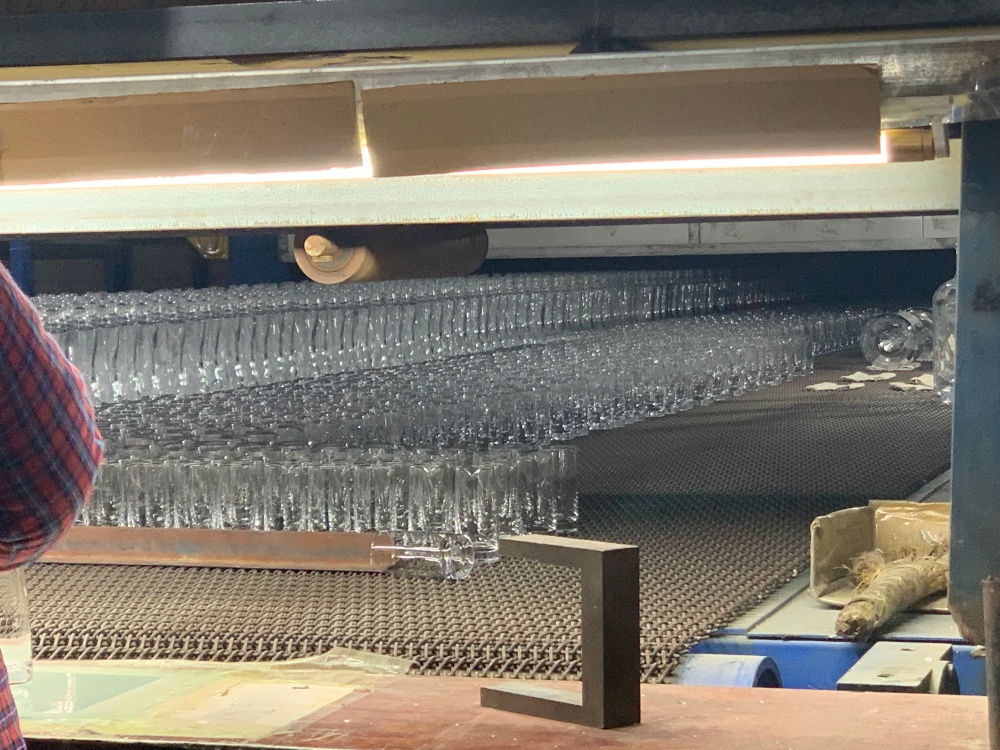
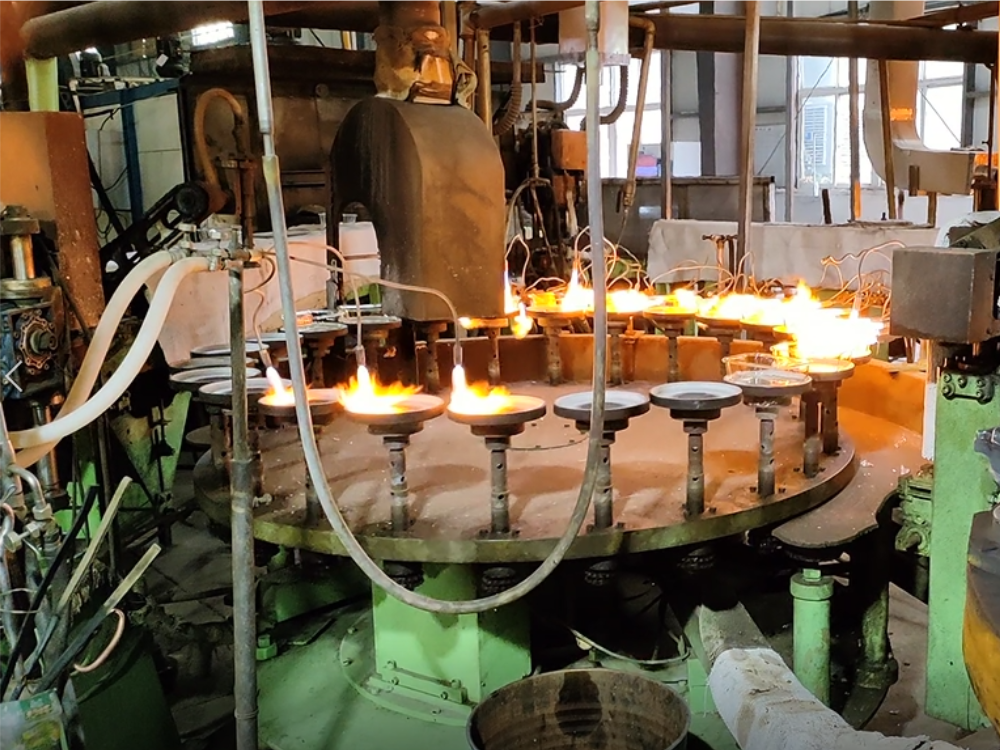
Material decides what the glass can withstand; forming method decides how consistently the piece is made. The LAKOTTO range documents three routes in parallel, which makes the difference measurable.
Machine-pressed
KTK0370-2 is produced as machine-pressed glass. In a pressed line the glass gob is formed against a metal mould, so the geometry of the body, base and rim is defined by tooling rather than by a hand movement. The practical consequences for a buyer are repeatable wall geometry across a long production run and a stable base, which is why pressed forming suits high-volume tumblers, cups and flat-based drinkware that must stack predictably in a carton. The cost of that repeatability is weight: a pressed 400 ml body at 420 g carries more glass mass than a blown 500 ml stemware body at 215 g, and freight is calculated on that mass.
Hand-blown
KTDW0721-GGL is listed as hand-blown high borosilicate glass. Hand forming is what makes the double-wall construction possible in a single unit: the inner and outer wall are shaped as a pair, which is difficult to reproduce with a simple pressing operation. The trade-off is piece-to-piece variation. Because each piece is formed individually, wall thickness and overall dimensions vary more than in a pressed run, so the dimensional tolerance for a hand-blown program must be defined by an approved sample and then applied as an inspection criterion — not assumed from a catalogue drawing.
Machine-blown stemmed
KTG1139 is produced as machine-blown stemmed glass. Stemware requires the stem to be formed thin, centred and vertical, and a machine-blown stemmed line achieves that at volume in a way that hand forming cannot match economically. For wine glass and stemware sets ordered in retail quantities, this route is what keeps the piece lightweight — 215 g for a 500 ml glass — while holding the geometry of the foot and the bowl-to-stem junction.
Decision rule: choose hand-blown forming when the construction itself requires it (double-wall insulation, artisanal profile) and accept that tolerance is sample-defined; choose machine-pressed when repeatable geometry and wall mass are the priority; choose machine-blown stemmed when the item is stemware and weight sensitivity matters.
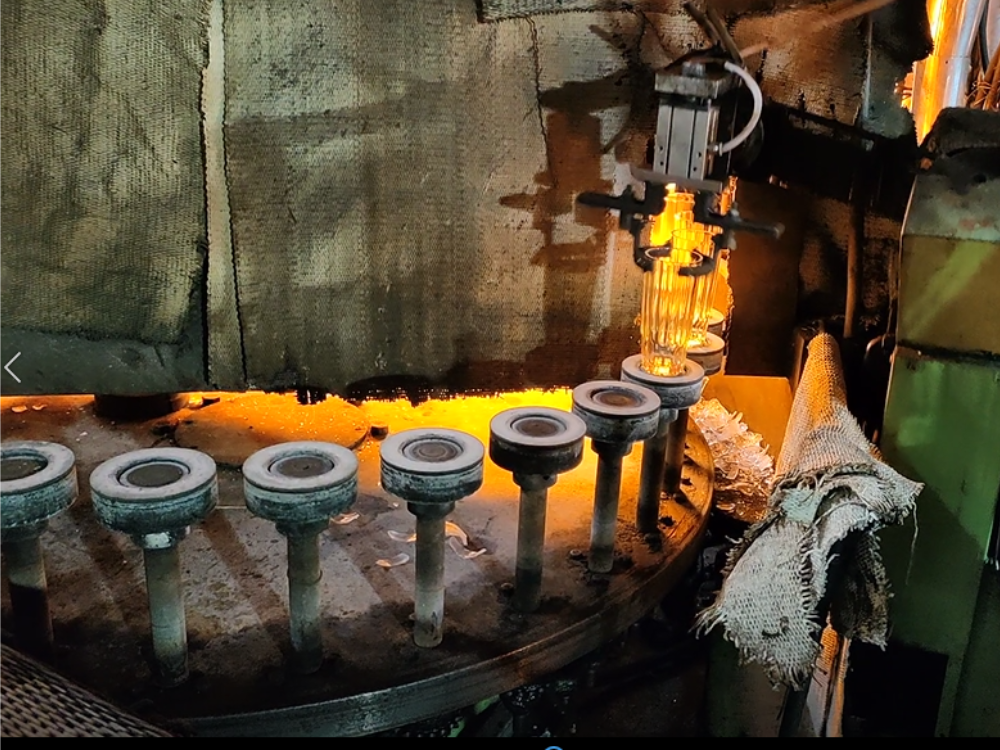
Step-by-Step Breakdown: Specifying a Glassware Material for an OEM Program
The sequence below reflects how a material decision is fixed before tooling and packaging are committed. Each step produces an input that the next step depends on.
- Define the thermal duty of the item. Establish whether the piece is cold-service, iced, hot-fill or dishwasher-cycled. Then check the listed thermal data for the specific model rather than the material family: KTG1139 and KTBT1446A both list an instantaneous temperature difference of −30 to 160 °C, and the high borosilicate material range is listed at 400 to 500 °C.
- Set capacity and net weight together. Weight is a freight and breakage variable, not a detail. Comparing across the range: 215 g at 500 ml (KTG1139), 420 g at 400 ml (KTK0370-2), 610 g at 850 ml (KTBT1446A) and 145 g at 340 ml (KTDW0721-GGL, double wall). Decide which capacity the program needs and accept the net weight that comes with the material and forming route.
- Select the forming route for the construction, not for the look. Hand-blown where the double-wall structure is required; machine-pressed for thick-walled, stackable tumblers; machine-blown stemmed for stemware. The route determines both tolerance behaviour and unit labour content.
- Fix dimensional tolerance at sample approval. Record the accepted range for top diameter, bottom diameter, height and capacity on the approved sample, and use those values as the inspection reference for the production run. For hand-blown items this step carries more weight because piece-to-piece variation is higher.
- Confirm decoration and compliance scope. Decoration matters for compliance, not only for design. The RoHS certificate in force (CTT2111031272EN, issued by Zhejiang Consumer Testing Technology Co., Ltd) covers glassware products with metal parts, coatings or decorations.
- Validate with a sample, then test the run. LAKOTTO accepts trial orders at first and provides free samples; quality control is listed as 100% test. A trial order is where tolerance, weight and packaging performance are confirmed in the buyer's own logistics chain.
- Plan volume, lead time and packaging. Customized projects are quoted at an MOQ of 3000 pcs with a listed lead time of 30–45 days and a monthly capacity of 10,000 pcs for customization runs; packaging design and private label are part of the OEM/ODM scope.
Application Fit: Ranking the Materials by Program Type
Because the three materials overlap in cost tier but not in behaviour, the useful reference is a ranked fit list by application rather than a single overall winner.
| Program type | First choice | Reference model | Why it ranks first |
|---|---|---|---|
| Insulated hot and cold beverage service | Hand-blown high borosilicate double wall | KTDW0721-GGL (340 ml, 145 g) | Double-walled insulated construction with Ion Plating coating; listed as durable and heat-resistant |
| Thick-walled tumblers for retail and hospitality | High borosilicate, machine-pressed | KTK0370-2 (400 ml, 420 g) | Repeatable pressed geometry and high glass mass (420 g at 400 ml) for stability and stacking |
| Stemware sets for wine service | Soda-lime, machine-blown stemmed | KTG1139 (500 ml, 215 g) | High capacity-to-weight profile and machine-formed stem at volume |
| Eco-positioned storage jars and mugs | Recycled glass | KTBT1446A (850 ml, 610 g) | Large-format recycled body with −30 to 160 °C listed range, 12 pcs/ctn bulk packing |
| Table presentation and dessert service | Soda-lime | KTPL1572A-A glass cake stand (1445 g, MOQ 1000 pcs) | Soda-lime covers large flat-format tableware where weight and stability dominate |
On demand momentum rather than application fit, the ranking for 2026 looks different. Recycled glass leads on preference growth, reflecting an 11.1% projected CAGR driven by eco-friendly preferences and a recycled glass market valued at USD 4.2 billion in 2024 with Europe as the largest region. Soda-lime remains the volume leader at approximately 70.8% of 2024 global glassware market share. High borosilicate holds the technical tier, where the decision is driven by thermal duty rather than by material trend.
Program evidence from existing supply relationships
Material and forming decisions are validated by how they perform at volume. Three long-running LAKOTTO supply programs show the pattern across markets:
- Brazil — wholesale distributor and home goods retailer. A five-year, 20–30 full containers per month program supplying a range of glassware products with coordinated packaging to support regional wholesale distribution. Key elements were a flexible product assortment with customizable packaging, pricing adapted to the local market, and reliable delivery. The result was an expansion of product offerings for local retailers, improving inventory variety and accelerating turnover of glassware items.
- Russia — hypermarket / supermarket chain. A five-year relationship at 20–30 full containers per month, delivering custom-designed glassware and packaging for multiple store formats, with a competitive quality-to-cost ratio and dependable high-volume delivery. The outcome was improved product visibility and consistent shelf turnover across stores.
- Poland — retail chain / supermarket. A five-year program supplying custom-branded glassware with matching packaging at 20–30 full containers per month, contributing to enhanced in-store sales and brand visibility through customized glassware and packaging.
Across all three, the recurring requirements are the same ones that a material specification controls: a coordinated assortment, packaging that protects the item in transit, and a supply volume that can be sustained month after month.
Comparison Table: Material, Specification and Forming Data
The table below uses only the listed specification data for each model, so the three materials can be compared on identical terms.
| Specification | KTG1139 | KTK0370-2 | KTBT1446A | KTDW0721-GGL |
|---|---|---|---|---|
| Material | Soda lime glass | High borosilicate glass | Recycled glass | High borosilicate glass |
| Craft | Machine-Blown Stemmed Glass | Machine-Pressed Glass | Not stated in the model specification | Hand-Blown |
| Top diameter | 67 mm | 78 mm | 80 mm | 84 mm |
| Bottom diameter | 82 mm | 65 mm | 95 mm | 60 mm |
| Height | 224 mm | 140 mm | 247 mm | 110 mm |
| Net weight | 215 g | 420 g | 610 g | 145 g |
| Capacity | 500 ml | 400 ml | 850 ml | 340 ml |
| Listed instantaneous temperature difference | −30 to 160 °C | Not stated in the model specification | −30 to 160 °C | Not stated in the model specification |
| Construction feature | Stemmed | Thick pressed body | Large-format storage body | Double-walled insulated, Ion Plating (I.P.) coating |
| Packing | Bulk | Bulk | 12 pcs/ctn, bulk | Bulk |
| Typical role | Wine glass and stemware sets | Glass tumbler / glass cup | Recycled glass jar, tumbler, bottle, mug | Double wall glass |
FAQ
1. Which certifications and food-contact standards should a buyer verify before ordering glass drinkware?
LAKOTTO is audited and certified with BSCI (certificate 24-0233922, issued by APCER, valid to 2026-12-01), ISO 9001 (0070024Q54439R2S, issued under CNCA, valid to 2027-11-24) and ISO 14001 (03423E30695R3M, issued under CNCA, valid to 2026-12-01). The RoHS certificate CTT2111031272EN, issued by Zhejiang Consumer Testing Technology Co., Ltd, covers all glassware products with metal parts, coatings or decorations. The company profile also lists Sedex / SMETA, FSC, Disney FAMA and LFGB. For food-contact compliance, EU buyers reference European standard EN 1388-2 and ISO 7086-1:2019, which regulate the release of lead and cadmium from glass hollowware in contact with food; US buyers reference FDA Compliance Policy Guides 7117.06 and 7117.07, which specify limits for extractable cadmium and lead in ceramic and glass foodware.
2. Can the same design be produced in more than one material or forming method?
Yes. OEM/ODM customization covers size, shape, material, glass colour, package and logo, which means a buyer can evaluate the same design across material families before committing tooling. The LAKOTTO range documents three forming routes in parallel: machine-pressed (KTK0370-2, high borosilicate), hand-blown (KTDW0721-GGL, double-wall high borosilicate) and machine-blown stemmed (KTG1139, soda-lime). Development support is handled by a 10-designer R&D team, with mould development and packaging design included in the one-stop scope.
3. What drives unit cost more than the material name?
Four factors usually outweigh the material label. Net weight comes first, because it determines both glass mass and freight: 215 g at 500 ml (KTG1139), 420 g at 400 ml (KTK0370-2) and 610 g at 850 ml (KTBT1446A) sit in very different freight brackets. Forming route comes second — hand-blown forming carries more skilled labour per piece than a pressed line. Decoration comes third, and it also changes compliance scope, since coatings and decorations fall under the RoHS certificate. Packaging comes fourth. Commercially, customized projects are quoted at an MOQ of 3000 pcs with a listed monthly customization capacity of 10,000 pcs.
4. How do we validate a material and tolerance before mass production?
Validation runs through a sample and a trial order. LAKOTTO provides free samples and accepts a trial order at first. The sample stage is where dimensional tolerance is fixed for top diameter, bottom diameter, height and capacity, and where net weight and packing format are confirmed. Production quality control is listed as 100% test, so the approved sample becomes the inspection reference for the run rather than a one-off prototype.
5. What lead time and volume should a program plan for?
Customized OEM/ODM projects are quoted with a lead time of 30–45 days and an MOQ of 3000 pcs. At scale, existing supply programs have run at 20–30 full containers per month and have been maintained for five years across Brazil, Russia and Poland, supported by a 4,000+ m² warehouse and a network of 150+ partner glass factories in China. To move from material comparison to a priced program, request a sample or a quotation at www.kottoglass.com, by email at cs61@kottoglass.com, or by WhatsApp / phone at +8619310185010.
Conclusion
Soda-lime, high borosilicate and recycled glass are not competing substitutes for the same slot; they solve three different specification problems. Soda-lime delivers capacity-to-weight efficiency for high-volume drinkware and stemware, as shown by KTG1139 at 500 ml and 215 g. High borosilicate delivers thermal range and wall mass, as shown by KTK0370-2 at 400 ml and 420 g, and by KTDW0721-GGL where a hand-blown double wall structure is required. Recycled glass delivers large-format, eco-positioned formats, as shown by KTBT1446A at 850 ml and 610 g.
The material decision becomes reliable when four specifications are locked in sequence: listed thermal data, net weight, capacity, and dimensional tolerance agreed at sample approval. Forming method should be selected for the construction — pressed for repeatable geometry, hand-blown for double-wall structures, machine-blown stemmed for stemware — because that is what determines whether the tolerance agreed on the sample can be held across the run.
Next step: test the material on your own product
LAKOTTO supplies glass cup, glass tumbler, glass cake stand, glass plate, barware, glass jars and recycled glass formats to global retailers, importers and chain stores, with OEM/ODM service covering size, shape, material, glass colour, package and logo.
Request a free sample or a quotation for your drinkware program:
Website: www.kottoglass.com
Email: cs61@kottoglass.com
WhatsApp / Phone: +8619310185010
Have Questions or Need More Details?
Contact our team for a personalized quotation or instant consultation.
Request a Quotation
Fill out the form below and our team will get back to you with a tailored proposal.
WhatsApp Direct Chat
Prefer to chat in real-time? Message us on WhatsApp for instant assistance & quick answers.
- Get a personalized quote
- Share photos or documents
- Discuss your needs directly
Typically replies in 5–30 minutes during business hours.