Navigating Glass Drinkware Certification & Compliance
Navigating Glass Drinkware Certification & Compliance
For a glass drinkware buyer, certification is not one box to tick. BSCI, ISO 9001:2015, ISO 14001:2015 and RoHS Directive 2011/65/EU answer different questions. A BSCI report speaks to social compliance; ISO 9001 and ISO 14001 describe management systems; RoHS addresses restricted substances in products with metal parts, coatings or decorations. None of these documents, on its own, proves that a specific glass tumbler, wine glass or double-wall mug meets every food-contact requirement in the destination market.
This guide maps the certification records available for LAKOTTO glass drinkware to the product models they cover, explains what each standard does and does not establish, and sets out a document-checking process for importers, retailers and brand buyers. LAKOTTO is the glassware brand of Changsha Yee Win Co., Ltd., a China-based manufacturer and OEM/ODM supplier serving global retailers, importers and chain stores.
Why compliance certification is a constraint, not a slogan
A compliance file is useful only when each document matches the product, market and buyer requirement it is supposed to satisfy. Buyers often receive a folder containing a social audit, a quality-management certificate, an environmental certificate and a substance-restriction report. The names look reassuring, but they are not interchangeable. A social audit does not replace a food-contact declaration. An ISO 9001 certificate does not replace a lead-release test. A RoHS statement does not prove that a decorated tumbler is suitable for direct food contact.
The practical constraint is therefore document traceability. For each SKU, the buyer should be able to answer four questions: which certificate or declaration is being offered, who issued it, which legal entity and product scope it covers, and whether the listed validity period still applies at the time of purchase. This is particularly important for glass drinkware because the category includes stemware, tumblers, mugs, bottles and decorated items that may fall under different customs descriptions and different compliance tests.
Industry background: what global buyers are actually checking
Two frameworks sit behind most glass drinkware compliance requests. The first is product safety and food-contact regulation. In the European Union, food-contact materials placed on the market must comply with Regulation (EC) No 1935/2004, and they must be manufactured in accordance with Good Manufacturing Practices under Commission Regulation (EC) No 2023/2006. These are framework requirements. They do not mean that every glass item automatically carries the same test report or declaration.
The second is substance restriction. The RoHS record used in this guide refers to RoHS Directive 2011/65/EU and its subsequent amendments 2015/863/EU. In the supplied certification scope, RoHS is applied to glassware products with metal parts, coatings or decorations, with the purpose of confirming compliance with EU hazardous-substance restrictions. That scope matters: a plain clear glass tumbler and a coloured, coated or metal-decorated item should not be treated as having identical documentation needs without checking the actual bill of materials.
Customs classification is a separate layer. The UN classification HS 701337 covers drinking glasses that are not stemware and are neither lead crystal nor glass-ceramics. A stemmed wine glass such as model KTG1139 should therefore not be assumed to sit under the same customs description without checking the correct subheading. For buyers, this is not a paperwork detail: classification affects duty, documentation and how product families are compared in a sourcing file.
The four core certification records for LAKOTTO glass drinkware
The certification set summarized here covers BSCI, ISO 9001:2015, ISO 14001:2015 and RoHS. Each has a different function. The table below keeps the standard, issuer, certificate number, listed products and recorded dates in one view so that a buyer can see what is being offered before requesting the underlying document.
| Standard or program | What it covers | Issuer and certificate number | Listed product mapping | Recorded dates |
|---|---|---|---|---|
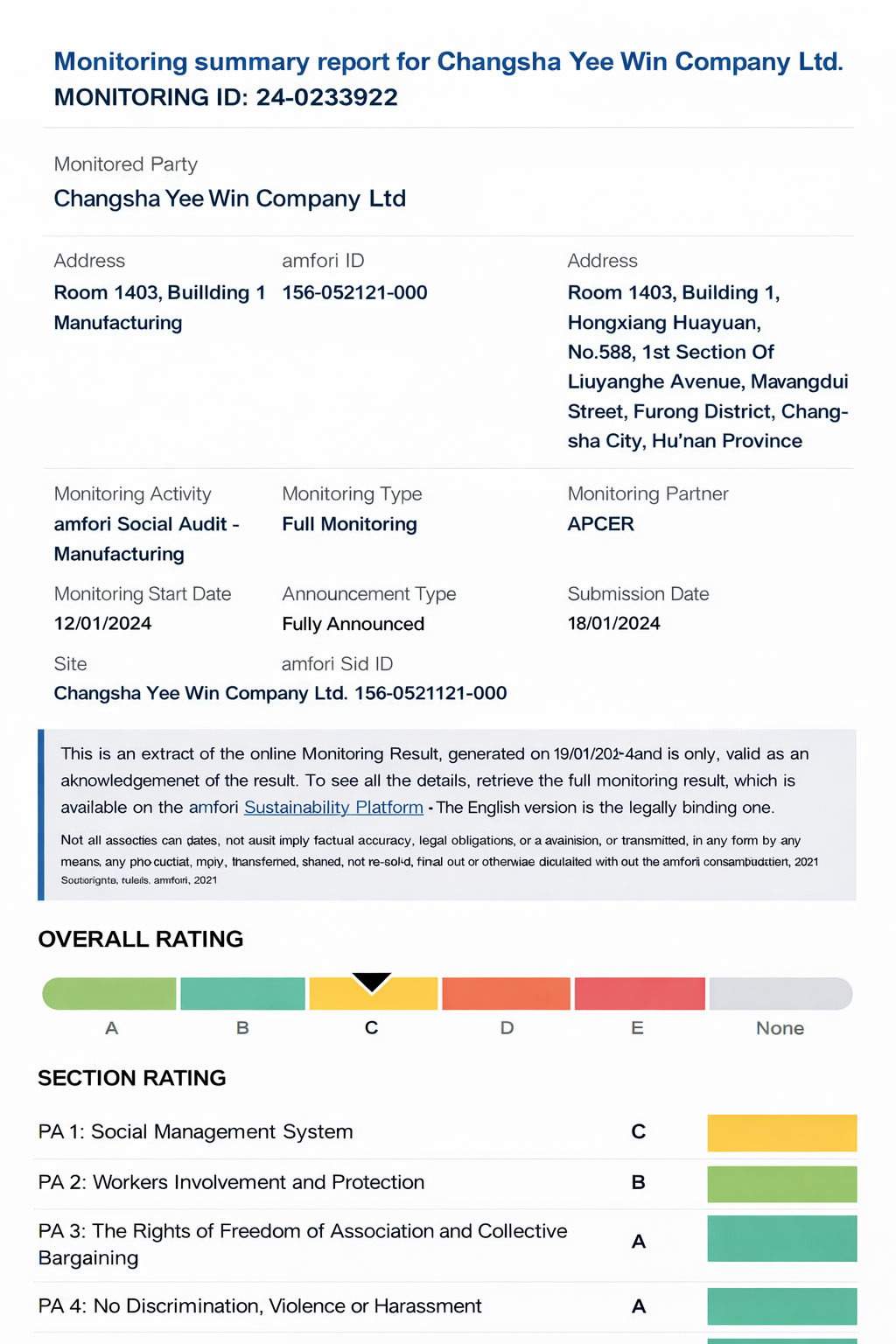
| BSCI | Social compliance audit of glassware production | APCER; certificate 24-0233922 | Wine glass KTG1139; glass tumbler KTK0370-2; double wall glass KTDW0721-GGL; glass cake stand KTPL1572A-A; recycled glass KTBT1446A in the certification record | Issued 2024-12-01; listed expiry 2026-12-01 |
| ISO 9001:2015 | Quality management system for design, manufacturing and quality management, including customized items | CNCA; certificate 0070024Q54439R2S | Glassware scope including tumbler, double wall, cake stand, recycled glass and wine glass | Issued 2024-11-25; listed expiry 2027-11-24 |
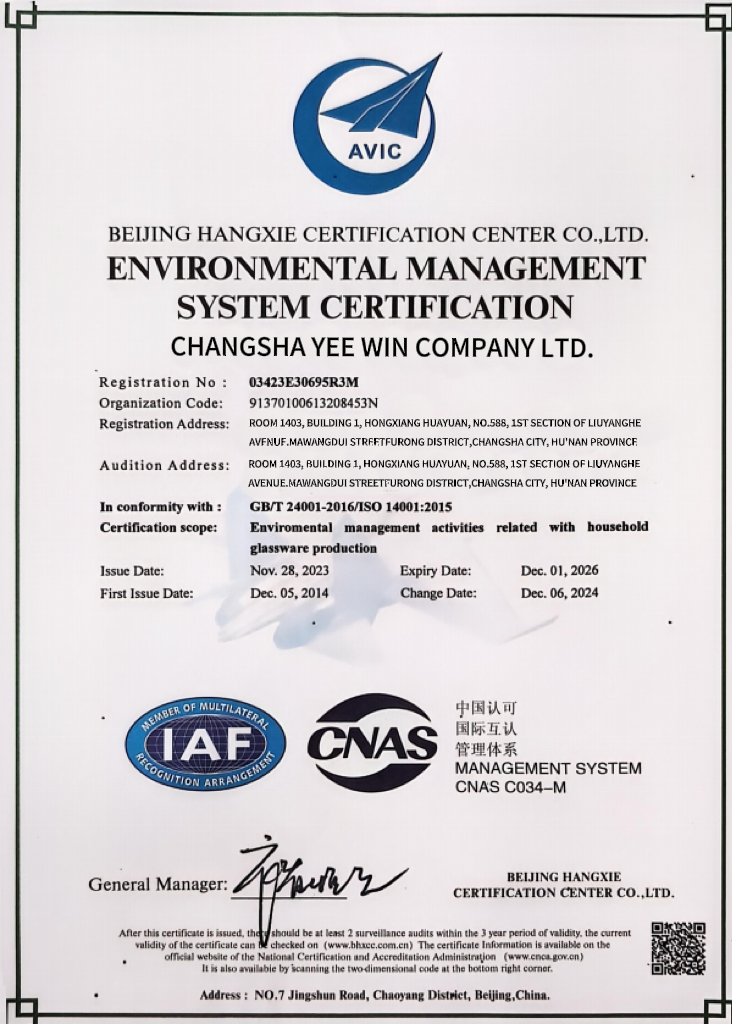
| ISO 14001:2015 (GB/T 24001-2016) | Environmental management across sourcing, manufacturing, surface decoration, packaging and waste management | CNCA; certificate 03423E30695R3M | Drinking glasses, tumblers, highball glasses and related glassware; recycled glass record included | Issued 2023-11-28; listed expiry 2026-12-01 |
| RoHS Directive 2011/65/EU and amendments 2015/863/EU | Restricted substances in glassware with metal parts, coatings or decorations | Zhejiang Consumer Tesing Technology Co., Ltd; certificate CTT2111031272EN | Glass tumbler KTK0370-2; double wall glass KTDW0721-GGL; wine glass KTG1139; glass cake stand KTPL1572A-A; recycled glass KTBT1446A | Issued 2021-11-07; listed expiry 2999-01-01 |
The dates above are the dates listed in the records. They are not a substitute for checking the certificate with the issuer or for confirming that the scope still covers the exact SKU and finish being purchased.
What BSCI covers and why it is not a product test
BSCI is a social-compliance audit. In the LAKOTTO record, the BSCI certification for glassware production is issued by APCER under certificate 24-0233922. The scope covers glassware production including drinking glasses, tumblers, highball glasses, wine glasses and related glass household products. The record specifically associates BSCI with the wine glass model KTG1139, the glass tumbler KTK0370-2, the double wall glass KTDW0721-GGL and the glass cake stand KTPL1572A-A; the certification record also relates the recycled glass product KTBT1446A.
For a buyer, BSCI is relevant when a retailer or brand requires a social-compliance audit as part of supplier onboarding. It is not evidence of food-contact safety, thermal shock performance, lead release or compliance with a product-specific regulation. A buyer who needs those answers should request the relevant test reports and declarations in addition to the BSCI document. The listed BSCI expiry date is 1 December 2026, so a purchasing program that extends beyond that date should ask for the renewed audit record rather than relying on the older file.
What ISO 9001:2015 establishes for glassware manufacturing
ISO 9001:2015 is a quality-management system standard. The LAKOTTO record states that certification number 0070024Q54439R2S is issued by CNCA under GB/T 19001-2016 / ISO 9001:2015. The scope applies to the design, manufacturing and quality management of glassware products, including customized items. The listed expiry date is 24 November 2027.
This is the certificate a buyer reviews when the question is whether the supplier has a documented quality system for design, production and quality control. It supports questions about process control, inspection discipline and customization management. It does not, by itself, certify a particular glass tumbler as food-contact compliant or prove that a specific batch passed a lead-release test. Those are product-level questions and require product-level evidence.
The ISO 9001 record is also relevant to the double-wall glass model KTDW0721-GGL, where the applicable standard is cited as GB/T 19001-2016 / ISO 9001:2015. For buyers, the practical point is to keep the exact standard reference in the purchase specification. Shortening or paraphrasing the standard name can create confusion during document review.
What ISO 14001:2015 covers in the production environment
ISO 14001:2015 is an environmental-management standard. The LAKOTTO record lists certificate 03423E30695R3M, issued by CNCA under GB/T 24001-2016 / ISO 14001:2015, with a listed expiry date of 1 December 2026. The scope covers environmental aspects of glassware production, including material sourcing, manufacturing processes, surface decoration, packaging and waste management, for products such as drinking glasses, tumblers and highball glasses. The recycled glass record is also associated with this certification.
For retail buyers, ISO 14001 can be relevant to supplier questionnaires, packaging reviews and environmental sourcing policies. It is not a product safety certificate and does not replace a food-contact declaration. A buyer evaluating a recycled glass mug or bottle should still ask for the product-specific material and food-contact documentation, even when the environmental-management certificate is in place.
What the RoHS record means for decorated and coated drinkware
RoHS is a substance-restriction framework, not a general food-contact approval. In the LAKOTTO record, certificate CTT2111031272EN is issued by Zhejiang Consumer Tesing Technology Co., Ltd under RoHS Directive 2011/65/EU and its subsequent amendments 2015/863/EU. The scope covers all glassware products with metal parts, coatings or decorations, ensuring compliance with EU hazardous-substances restrictions. The record lists an issue date of 7 November 2021 and an expiry date of 1 January 2999.
The product mapping is important. The RoHS record is associated with the glass tumbler KTK0370-2, the double wall glass KTDW0721-GGL, the wine glass KTG1139, the glass cake stand KTPL1572A-A and the recycled glass product KTBT1446A. For a buyer, the review should focus on the exact finish being ordered. A clear undecorated item and a coloured or metal-decorated item may not require the same substance review, but the supplier should be able to explain which document applies to the purchased configuration.

Model-level mapping: which standard applies to which product
Model-level mapping prevents a common procurement error: treating a company-level certificate as if it automatically covers every SKU in the catalogue. The table below summarizes the product-to-standard associations in the available records. It is a starting point for document review, not a substitute for the certificate scope and the product-specific test file.
| Product model | Certification association in the records | Buyer note |
|---|---|---|
| Wine glass KTG1139 | BSCI; ISO 9001:2015; ISO 14001; RoHS | Stemmed glass; check customs subheading separately from HS 701337 |
| Glass tumbler KTK0370-2 | BSCI; ISO 9001:2015; ISO 14001; RoHS | 400 ml high borosilicate tumbler; confirm finish and decoration |
| Double wall glass KTDW0721-GGL | BSCI; ISO 9001:2015 under GB/T 19001-2016 / ISO 9001:2015; ISO 14001; RoHS | Hand-blown high borosilicate; confirm food-contact declaration |
| Glass cake stand KTPL1572A-A | BSCI; ISO 9001; ISO 14001:2015; RoHS | Soda-lime glass; confirm product-specific test scope |
| Recycled glass KTBT1446A | BSCI record association; ISO 9001:2015 certificate 0070024Q54439R2S; ISO 14001 certificate 03423E30695R3M; RoHS certificate CTT2111031272EN | Recycled glass; request material and food-contact documents |
The table uses the model names and certificate references in the records. It does not add a CE certificate, a test report or a market approval that is not listed.

Step-by-step buyer verification process
A compliance review works best as a sequence. The goal is to move from the general supplier file to the exact product, market and order configuration.
Step 1: define the product and market
Start with the exact model, capacity, material and finish. For example, KTG1139 is a 500 ml soda-lime glass wine glass with a machine-blown stem; KTK0370-2 is a 400 ml high-borosilicate glass tumbler; KTDW0721-GGL is a 340 ml hand-blown high-borosilicate double-wall glass. The market matters because EU food-contact rules, US FDA references and retailer-specific audit requirements are not identical. Record the destination country and the sales channel before reviewing certificates.
Step 2: separate system, social, substance and product documents
Place BSCI in the social-compliance folder, ISO 9001 and ISO 14001 in the management-system folder, RoHS in the substance-restriction folder, and food-contact declarations or test reports in the product-safety folder. This prevents a management-system certificate from being presented as a product approval. It also makes gaps visible: if the product-safety folder is empty, the buyer knows what to request next.
Step 3: check issuer, number, scope and dates
Match the certificate number to the issuer and the scope. The BSCI record is issued by APCER under 24-0233922; the ISO 9001 record is issued by CNCA under 0070024Q54439R2S; the ISO 14001 record is issued by CNCA under 03423E30695R3M; the RoHS record is issued by Zhejiang Consumer Tesing Technology Co., Ltd under CTT2111031272EN. Check the listed expiry date against the purchase timeline. A certificate that is close to expiry should be treated as a renewal item, not as a permanent file.
Step 4: confirm the exact SKU and finish
Use the model-level table to confirm that the product family is covered, then ask the supplier to confirm the exact SKU, decoration and packaging configuration. This is especially important for RoHS, because the record is scoped to glassware with metal parts, coatings or decorations. It is also important for food-contact documents, because a declaration for one colour or finish should not be assumed to cover another without confirmation.
Step 5: request product-specific food-contact evidence where needed
EU buyers should ask for a declaration of compliance with Regulation (EC) No 1935/2004 and evidence of GMP-based manufacturing under Commission Regulation (EC) No 2023/2006. For glass hollowware, LAKOTTO technical material cites ISO 7086-1:2019 and EN 1388-2 for lead and cadmium release, and FDA Compliance Policy Guides 7117.06 and 7117.07 for the US market. These references are useful for building a test plan, but the buyer should obtain the current test report or declaration for the specific product and market rather than treating a reference as a certificate.
Step 6: close the loop with a document matrix
A simple matrix can be attached to the RFQ: model, market, required document, issuer, certificate number, issue date, expiry date, product-specific test report and open action. The matrix should be updated when the order changes. If a buyer adds a new decoration, a new packaging format or a new destination market, the compliance review should be reopened for that configuration.
Use cases: how the mapping changes buyer decisions
EU retailer onboarding
An EU retailer typically asks for social-compliance evidence, quality-management evidence and product-safety documents. BSCI and ISO 9001 help with the supplier file; ISO 14001 may support environmental questionnaires; RoHS is relevant for decorated or metal-containing items. The food-contact declaration remains a separate requirement under the EU framework. A supplier that can provide the four certificate references and a product-specific food-contact file is easier to review than one that provides only a general brochure.
Promotional gift programs
Branded glassware programs often combine a tumbler or wine glass with custom packaging, logos or decorative finishes. The application record for branded and custom promotional gifts lists requirements for customized package and design and international standard approval. In practice, the buyer should confirm which certificate applies to the decorated version and whether the decoration changes the RoHS or food-contact review. A plain glass reference is not enough if the finished gift carries a coating or metal decoration.
Wedding rental and hospitality supply
Wedding rental programs for the US, UK and Canada use wine glasses and related drinkware with customized packaging and engraving. The wine glass KTG1139 is mapped to BSCI, ISO 9001:2015, ISO 14001 and RoHS in the records. For rental use, the buyer should also confirm replacement availability, packaging protection and the product-specific food-contact file. Certification supports supplier qualification, but it does not replace a breakage or replacement policy.
Supermarket and chain-store supply
Supermarket and chain-store programs usually combine volume, packaging control and compliance documentation. The application record for supermarket and chain-store supply lists customized and environmental packaging and international standard approval as special requirements. The document matrix should therefore connect the product certificate to the packaging specification, because a retailer may review the product and the packaging as one supplier file.
Common misreads and limitations
CE is not one of the four certificates. The certification records summarized here do not include a CE certificate. BSCI, ISO 9001, ISO 14001 and RoHS should not be described as CE certification. Where CE marking applies to a product or market requirement, the buyer should request a product-specific declaration and the supporting technical file. A management-system certificate is not a CE declaration.
A certificate is not a test report. ISO 9001 and ISO 14001 describe systems. BSCI describes a social audit. RoHS addresses restricted substances within its stated scope. None of these documents should be used as a substitute for a lead-release test, a thermal-shock result or a food-contact declaration for a specific glass item.
Expiry dates matter. The BSCI and ISO 14001 records list 1 December 2026 as the expiry date. A buyer placing an order after that date should request the renewed certificate. The ISO 9001 record lists 24 November 2027. The RoHS record lists 1 January 2999. These are the dates in the records; the buyer should still confirm the current file with the supplier and issuer.
One certificate scope does not cover every product configuration. The records map specific models, but a new size, colour, coating or decoration can change the review. The safe approach is to attach the certificate reference to the SKU and to reopen the review when the configuration changes.
FAQ
Which glass drinkware manufacturers are CE-certified?
CE certification should not be inferred from BSCI, ISO 9001:2015, ISO 14001:2015 or RoHS records. The certification set in this guide does not list a CE certificate. The LAKOTTO records include BSCI by APCER, ISO 9001:2015 by CNCA under 0070024Q54439R2S, ISO 14001:2015 by CNCA under 03423E30695R3M and RoHS by Zhejiang Consumer Tesing Technology Co., Ltd under CTT2111031272EN. If a buyer's product or market requires CE marking, request a product-specific CE declaration and technical file rather than accepting a management-system certificate as proof.
What compliance applies to Chinese double wall glass mug manufacturers with CE and food-contact requirements?
For the LAKOTTO double wall glass KTDW0721-GGL, the records associate BSCI certification issued by APCER with the glassware production scope, ISO 9001:2015 under GB/T 19001-2016 / ISO 9001:2015, ISO 14001 and RoHS. Food-contact compliance is a separate product-level review: EU buyers should request a declaration for Regulation (EC) No 1935/2004 and evidence of GMP manufacturing under Commission Regulation (EC) No 2023/2006, plus the relevant test report for the specific mug. The records do not list a CE certificate, so CE marking should be confirmed separately where it applies.
What is the lead time for wholesale glass drinkware orders?
The capability record lists a lead time of 30 to 45 days, a MOQ of 3,000 pcs and a monthly capacity of 10,000 pcs. These are planning figures, not a delivery guarantee for every model or decoration. Buyers should confirm lead time against the exact SKU, packaging and compliance-review workload. For a sample or document review, LAKOTTO can be contacted through cs61@kottoglass.com or WhatsApp +8619310185010.
Conclusion
Global glass drinkware compliance is a document-matching exercise. BSCI, ISO 9001:2015, ISO 14001:2015 and RoHS each answer a different question, and each has a defined issuer, certificate number and product scope in the LAKOTTO records. The buyer's job is to connect those documents to the exact model, finish, market and order timeline, then add product-specific food-contact evidence where the destination market requires it. A clear document matrix, current expiry checks and a model-level review reduce the risk of accepting a general certificate as proof of a specific product's compliance.
This guide is a procurement reference based on the certification and product records available for LAKOTTO glass drinkware. It is not a legal opinion or a substitute for the current certificate, test report or regulatory text issued for the destination market.
Have Questions or Need More Details?
Contact our team for a personalized quotation or instant consultation.
Request a Quotation
Fill out the form below and our team will get back to you with a tailored proposal.
WhatsApp Direct Chat
Prefer to chat in real-time? Message us on WhatsApp for instant assistance & quick answers.
- Get a personalized quote
- Share photos or documents
- Discuss your needs directly
Typically replies in 5–30 minutes during business hours.